
AI Agents Hit Logistics Funding: What Brokers Should Automate First in 2026
HappyRobot’s Series C put AI agents in logistics headlines. Here’s what freight desks should automate first — document validation before generic agents.
2026-08-10 · 8 min read
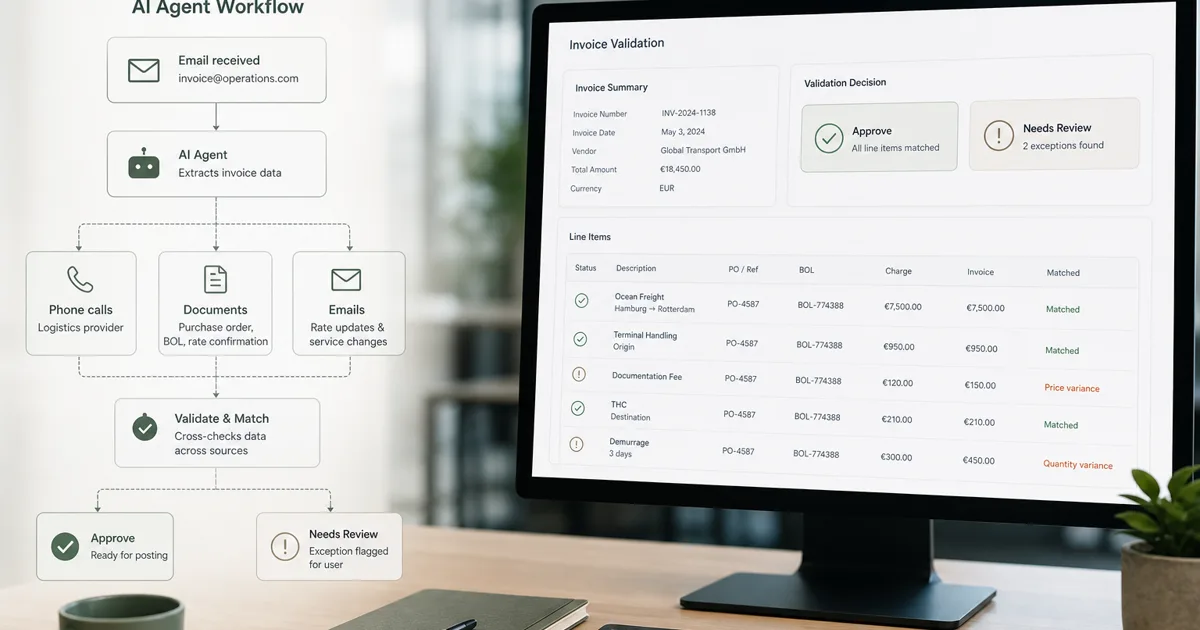
Why this funding round matters to ops desks
In early August 2026, HappyRobot closed a large Series C for AI agents that work across voice, email, documents, and existing enterprise systems — with deep roots in logistics customers. The signal to the market is clear: buyers want software that finishes operational jobs, not another chatbot bolted onto a TMS.
For freight brokers and 3PLs, that news creates budget conversations (“Should we buy agents?”) before it creates workflow clarity. The useful question is narrower: which bounded jobs leak money every week, and which ones are safe to automate first?
Agents execute work. Validation decides money.
AI agents shine when the job is coordination: chase a status, draft a reply, route an exception, pull data from three systems. Document validation shines when the job is financial control: does this carrier invoice match the rate confirmation and supporting evidence before AP pays?
Those are related — and different. An agent that files invoices faster without a match gate simply accelerates leakage. A validation layer that returns Approve / Needs Review / Reject with rule outcomes gives humans a defensible payment decision.
- Agent-shaped jobs: outreach, status chase, inbox triage, exception routing
- Validation-shaped jobs: linehaul/fuel match, accessorial evidence, duplicate holds, three-doc packets
- Buy agents for throughput; buy validation for margin and audit trail
What to automate first on a broker desk
Start where the packet already exists and the cost of being wrong is immediate. Most FTL desks already receive invoice + rate confirmation PDFs by email. That is the highest-ROI first automation in 2026 — not a greenfield agent platform.
- 1) Pre-pay match invoice ↔ rate confirmation (linehaul, fuel, refs)
- 2) Hold unauthorized accessorials / detention without POD timestamps
- 3) Duplicate invoice / PRO collision detection before remittance
- 4) Only then layer agents for chase, collect, and exception communication
How to evaluate AI logistics vendors without the hype
Ask whether the product completes a bounded job with measurable outcomes: exception rate, minutes per invoice, dollars held before payment. Ask whether humans remain the payment authority. Ask whether rules are explainable — CFOs and auditors hate black boxes on remittance.
Vertical context still wins. Generic agents that “do logistics” without freight document schemas, accessorial policy, and duplicate logic will stall at the demo. Category funding proves demand; it does not pick your first control.
Where Jorora sits in that stack
Jorora Freight Audit is the validation wedge: upload or forward the packet, extract fields, run deterministic rules, decide before AP. It is not a voice agent, not a TMS, and not a claim that agents are useless — it is the control you should install before you automate the chase.
If your team is reacting to AI-agent headlines this month, pilot validation on ten real FTL PDFs first. Two free credits are enough to see whether the desk’s real bottleneck is coordination — or unpaid variance.
Automate the payment gate first
Before you buy agents for chase work, view invoice ↔ rate con matching on a live sample — no TMS required.